Brampton is a city of big homes — spacious detached and semi-detached houses, many of them built in the last twenty or thirty years. And a lot of those homes come with a nasty surprise every January: a gas bill that seems far too high for a house that isn’t even that old.
Here’s the thing most homeowners don’t realize: a big house and a “new” house are both reasons your heating bill is high — not reasons it should be low. More square footage means more to heat. And “new” in Brampton often means “built to the minimum standard of its year, and settling ever since.”
The attic is usually where the money’s escaping. Here’s why, and what a large Brampton home actually needs.
Why a bigger home costs more than you’d expect
It’s not just proportional. A large home loses heat faster for a few reasons that stack up:
More ceiling area under the attic. The bigger the home’s footprint, the more ceiling there is for heat to escape through — and the attic sits over all of it. A thin attic on a big house is a big problem.
More volume of air to heat. Two-storey Brampton homes with open foyers and tall spaces hold a lot of air, and all of it has to be heated. Warm air rises and collects up high, then leaks into the attic if the ceiling isn’t sealed.
The stack effect is stronger in a tall house. Warm air rises and pushes out through the upper level and attic, pulling cold air in low. The bigger and taller the house, the harder that runs — hardest in the January cold you’re paying to fight.
So a large home doesn’t just cost more to heat because it’s bigger — it costs more because it loses heat faster, and the attic is where most of that loss happens.
“But my house is newer” — why that doesn’t mean efficient
This is the part that surprises people. A home built in 1998, or even 2010, is not insulated to a high standard just because it’s newer than a century home. Two things are at play:
It was built to the minimum of its year. Builders insulate to the code minimum of the build date — that’s the business. The minimum in 1998 was well below where an attic should sit today. Your “newer” home may have started at a number you’d now consider low.
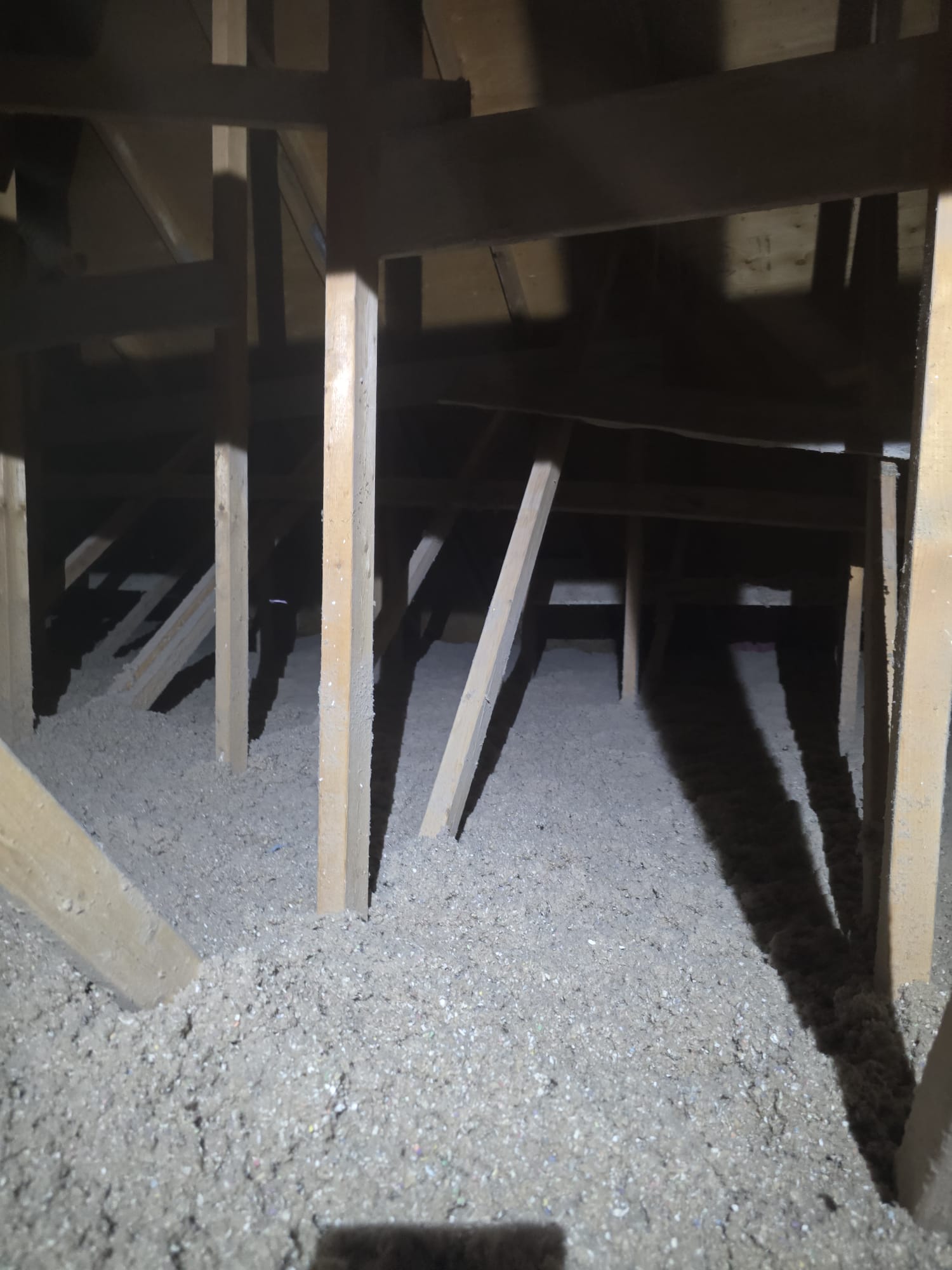
Loose-fill insulation settles. Whatever was blown into your attic at construction has been compressing under its own weight ever since. A home that started at, say, R-40 twenty years ago measures less than that today. Every lost inch is lost R-value and higher bills.
Add the production-build reality — big subdivisions built fast, where attic details like air sealing and baffles get the minimum attention — and a lot of Brampton homes are running well below what they should. The upside: that means real savings are available once it’s done right.
Measure what you’ve actually got — five minutes
Don’t assume from the age of the house. Measure.
- Open the attic hatch, shine a light, step only on joists
- Push a ruler to the drywall at several spots, including near the eaves
- Convert:
| Material | R per inch | 8 in | 12 in | 16 in |
|---|---|---|---|---|
| Blown cellulose | ~3.4 – 3.8 | ~R-28 | ~R-42 | ~R-56 |
| Blown fibreglass | ~2.7 – 3.0 | ~R-22 | ~R-34 | ~R-45 |
| Settled batts | ~2.5 – 3.2 | ~R-22 | — | — |
Target: R-50 minimum to qualify for the rebate, R-60 as the goal. A lot of Brampton homeowners who measure for the first time are surprised how far under they are.
Note on big homes: many larger Brampton homes have complex rooflines — multiple gables, bonus rooms over garages, bump-outs — which split the attic into several separate sections. Measure at more than one hatch if you can; it’s common for one section (often over a bonus room or a wing) to be shorted while the rest is fine.
The five things that get skipped — and cost you
Depth alone doesn’t fix a high bill. These do more of the work:
1. Air sealing the ceiling
Insulation slows heat conduction; it barely touches air movement. Your ceiling leaks warm air through unsealed penetrations — top plates, wiring, plumbing stacks, exhaust fans, and any pot lights (big Brampton homes have plenty). In a tall house with a strong stack effect, that leakage is a major cost. Seal first, insulate second.
2. Coverage to the eaves — across every section
The perimeter is shorted most often, and a big home has a lot of it. A solid R-50 that reaches the edges beats a patchy R-60 that stops short.
3. Baffles and ventilation
Blown-in buries soffit vents unless baffles hold them clear. Blocked venting causes moisture and ice dams. Baffle installation →
4. The attic hatch(es)
Usually bare, uninsulated panels — holes in your ceiling. A big home may have several.
5. Attic ductwork
Many larger Brampton two-storeys run HVAC ducts through the attic to reach the second floor. Uninsulated or leaky runs mean you’re heating the attic and starving the upstairs rooms. Blanket wrap insulation →
The cold room over the garage isn’t an attic problem
Very common in Brampton’s big homes: a bedroom or bonus room over the garage that’s always cold. That floor sits over an unheated garage, not the attic — so more attic insulation won’t fix it. It needs the garage ceiling done. Garage ceiling insulation →
What a proper job looks like
- Assess — measure each attic section, identify material, check ventilation, ductwork, penetrations
- Remove only if contaminated by mould, water, rodents or smoke
- Air seal the ceiling plane
- Install baffles, confirm soffit intake
- Insulate and weatherstrip every hatch
- Seal and insulate attic ductwork where present
- Blow to depth, to the eaves, in every section — R-50 minimum, R-60 target
- Mark depths so the result is verifiable
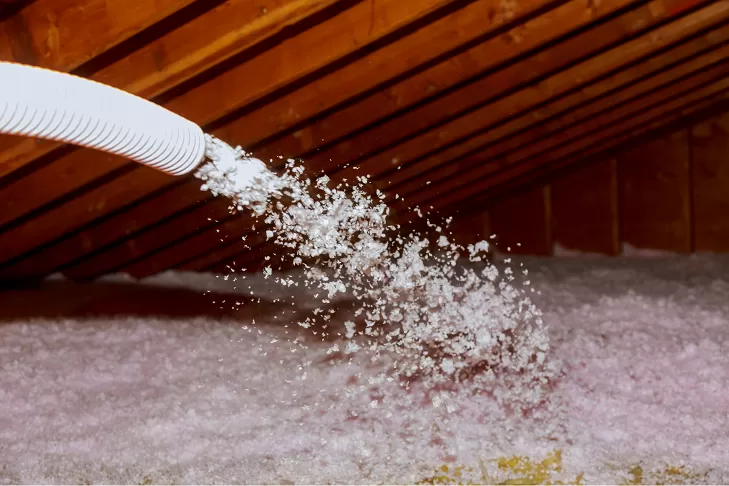
On material: with the headroom in a typical Brampton truss attic, either works. Cellulose reaches the target in less depth and is denser; fibreglass is lighter and usually the cheaper route to the same number. Both are rebate-eligible.
Cellulose blown-in → · Fibreglass blown-in → · Insulation removal →
Frequently asked questions
Why is my big house so expensive to heat? More ceiling area, more air volume, and a stronger stack effect — all pushing heat up and out through the attic. A large home loses heat faster, so the attic matters more, not less.
My home is newer. Shouldn’t the attic be fine? Not necessarily. It was insulated to the minimum of its build year and has settled since. Newer doesn’t mean efficient. Measure to be sure.
Why is one room or wing always colder? Big homes have complex attics split into sections. The cold room usually sits under a section that was under-insulated or missed — or over an uninsulated duct run.
Do I need to remove the old insulation? Only if it’s contaminated. Otherwise new goes over old and the R-values add.
Do I have to leave home during the work? No.
How long does it take? A straightforward top-up is usually a single day; a big home with multiple sections and duct work takes longer.
Find out where your money’s going — free assessment
If your Brampton home’s gas bill doesn’t match its age, the attic is the first place to look. A proper assessment measures each section, checks the ductwork and ventilation, and tells you exactly where the heat — and the money — is escaping.
Pro Insulation Contracting has insulated Ontario homes for over 10 years and serves Brampton and the surrounding area. Free on-site assessment, written scope, fixed price before any work starts.
📞 (416) 315-0471 · Book a free attic assessment →